Adam
Adam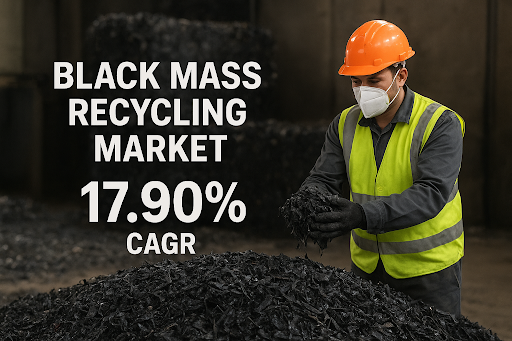
The Black Mass Recycling Market has emerged as one of the most critical segments within the global battery recycling and circular economy landscape. Driven by the exponential growth in electric vehicles (EVs), renewable energy storage systems, and consumer electronics, black mass recycling focuses on recovering valuable materials such as lithium, cobalt, nickel, manganese, and graphite from end-of-life lithium-ion batteries. These recovered metals play a vital role in reducing dependency on raw material mining while ensuring a stable and sustainable supply chain for next-generation batteries.
As governments and industries intensify efforts to meet sustainability goals, black mass recycling has gained strategic importance. Battery manufacturers are increasingly integrating recycled materials into new battery production, while policymakers worldwide are tightening regulations on battery disposal and recycling. This convergence of environmental, economic, and regulatory factors has positioned the Black Mass Recycling Market as a cornerstone of the global energy transition.
Black Mass Recycling Market Size and Growth Outlook
According to the SNS Insider, The Black Mass Recycling Market demonstrated strong momentum in recent years, reflecting its growing relevance in the global clean energy ecosystem. In 2024, the market stood at an estimated USD 14.41 billion and is anticipated to surge to approximately USD 53.79 billion by 2032, expanding at a robust compound annual growth rate of around 17.90% between 2025 and 2032. This remarkable growth trajectory underscores increasing investments in recycling infrastructure, technological advancements, and rising demand for battery-grade raw materials.
The market’s expansion is further supported by the rapid electrification of transportation and rising adoption of lithium-ion batteries across energy storage and industrial applications. As battery volumes entering the waste stream continue to rise, black mass recycling is becoming both an environmental necessity and an economically attractive solution.
Black Mass Recycling Market Key Growth Drivers
Several powerful drivers are shaping the Black Mass Recycling Market. One of the most significant factors is the surging demand for electric vehicles worldwide. As EV adoption accelerates, the volume of spent batteries requiring responsible disposal and recycling is increasing exponentially. Black mass recycling provides a cost-effective way to recover critical minerals that are otherwise expensive and environmentally damaging to mine.
Additionally, volatility in raw material prices has encouraged manufacturers to seek alternative sources of lithium, cobalt, and nickel. Recycling black mass helps stabilize supply chains and reduces exposure to geopolitical risks associated with mining-heavy regions. Environmental regulations mandating higher recycling rates and producer responsibility programs are also pushing companies to invest in advanced black mass processing technologies.
Black Mass Recycling Market Technology and Process Advancements
Technological innovation plays a crucial role in the evolution of the Black Mass Recycling Market. Modern recycling processes primarily involve mechanical pre-treatment followed by hydrometallurgical or pyrometallurgical extraction methods. Among these, hydrometallurgy is gaining strong traction due to its higher recovery rates, lower energy consumption, and reduced environmental impact.
Advanced separation and purification technologies are enabling recyclers to achieve battery-grade material quality, making recycled metals suitable for direct reuse in new battery manufacturing. Continuous research and development efforts are also focused on improving process efficiency, reducing chemical usage, and scaling up operations to meet growing market demand. These advancements are essential for making black mass recycling economically viable on a global scale.
Black Mass Recycling Market Challenges and Constraints
Despite its promising outlook, the Black Mass Recycling Market faces several challenges. One major obstacle is the lack of standardized battery designs, which complicates dismantling and recycling processes. Variations in battery chemistries require different treatment methods, increasing operational complexity and costs for recyclers.
High initial capital investment for recycling facilities and stringent regulatory compliance requirements can also act as barriers, particularly for small and medium-sized players. Additionally, inefficient collection systems in certain regions limit the availability of end-of-life batteries, affecting feedstock supply. Addressing these challenges will be crucial for sustaining long-term market growth.
Black Mass Recycling Market Regional Insights
Regional dynamics significantly influence the Black Mass Recycling Market. Asia-Pacific currently dominates the market, driven by strong EV manufacturing bases in China, Japan, and South Korea. China, in particular, benefits from well-established battery recycling regulations and large-scale processing capabilities.
Europe follows closely, supported by strict environmental policies, ambitious EV adoption targets, and the European Union’s emphasis on battery circularity. North America is also witnessing rapid growth, fueled by rising investments in domestic battery production and recycling infrastructure. Emerging markets in Latin America and the Middle East are expected to present new opportunities as EV penetration and recycling awareness increase.
Black Mass Recycling Market Future Trends and Opportunities
Looking ahead, the Black Mass Recycling Market is expected to witness significant opportunities through strategic partnerships between automakers, battery producers, and recycling companies. Vertical integration across the battery value chain will become increasingly common, ensuring secure access to recycled raw materials.
The integration of artificial intelligence and automation in recycling processes is another emerging trend, helping improve efficiency and reduce operational costs. As sustainability becomes a central focus for industries worldwide, black mass recycling will not only support environmental goals but also enhance long-term economic resilience for battery supply chains.
Black Mass Recycling Market FAQs
Q1: What is the CAGR of the Black Mass Recycling Market?
The Black Mass Recycling Market is projected to grow at a CAGR of 17.90% during the forecast period from 2025 to 2032, reflecting strong demand for recycled battery materials.
Q2: What is the forecast market size of the Black Mass Recycling Market?
The market is expected to expand from USD 14.41 billion in 2024 to approximately USD 53.79 billion by 2032, driven by EV growth and increased battery recycling initiatives.
Q3: Which regions are expected to drive growth in the Black Mass Recycling Market?
Asia-Pacific is projected to lead market growth, followed by Europe and North America, due to high EV adoption rates, supportive regulations, and expanding recycling infrastructure.