Adam
Adam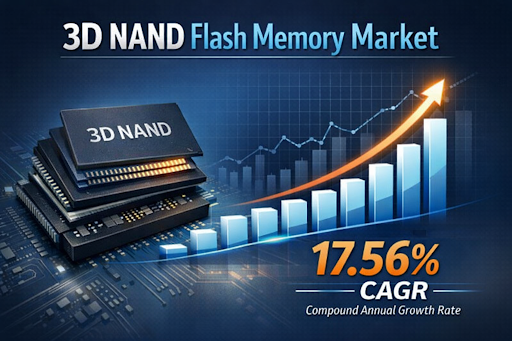
The 3D NAND Flash Memory Market has emerged as a cornerstone of the modern digital ecosystem, supporting data-intensive applications across consumer electronics, enterprise storage, cloud computing, artificial intelligence, and automotive electronics. Unlike traditional planar NAND, 3D NAND technology stacks memory cells vertically, significantly increasing storage density while reducing cost per bit and power consumption. As global data generation accelerates due to 5G, IoT, and edge computing, the demand for high-performance, scalable, and energy-efficient memory solutions continues to rise, positioning the 3D NAND Flash Memory Market for sustained long-term growth.
3D NAND Flash Memory Market Size and Growth Outlook
As per the SNS Insider, The 3D NAND Flash Memory Market demonstrated strong momentum in recent years and continues to show a robust growth trajectory. In 2024, the market was valued at USD 20.67 billion, and it is projected to expand substantially to reach USD 75.44 billion by 2032. This expansion reflects a solid compound annual growth rate (CAGR) of 17.56% during the forecast period from 2025 to 2032. The sharp rise in market value is attributed to increasing adoption of solid-state drives (SSDs), higher memory capacity requirements, and ongoing innovations in multi-layer NAND architectures.
Key Drivers Fueling the 3D NAND Flash Memory Market
One of the primary growth drivers of the 3D NAND Flash Memory Market is the rapid adoption of SSDs in consumer and enterprise applications. SSDs powered by 3D NAND offer faster read/write speeds, lower latency, and improved durability compared to traditional hard disk drives. Additionally, the exponential growth of cloud data centers is creating sustained demand for high-density memory solutions that optimize performance while reducing operational costs. The increasing penetration of AI, machine learning, and big data analytics further amplifies the need for advanced memory technologies, making 3D NAND a critical component of next-generation computing infrastructure.
Technological Advancements in the 3D NAND Flash Memory Market
Continuous innovation is a defining characteristic of the 3D NAND Flash Memory Market. Manufacturers are aggressively increasing the number of memory layers, moving from 100-layer to 200-layer and beyond, to enhance storage capacity without increasing the physical footprint. Advancements such as charge trap flash (CTF) architecture, improved error correction algorithms, and optimized controller designs are improving reliability and endurance. These technological improvements not only boost performance but also lower cost per gigabyte, enabling broader adoption across mid-range consumer devices and enterprise-grade storage systems.
Application Expansion Supporting the 3D NAND Flash Memory Market
The application landscape of the 3D NAND Flash Memory Market continues to diversify. In consumer electronics, smartphones, tablets, laptops, and gaming consoles increasingly rely on high-capacity NAND flash for seamless user experiences. In the enterprise segment, data centers and cloud service providers deploy 3D NAND-based SSDs to support virtualization, real-time analytics, and hyperscale storage environments. The automotive sector is also emerging as a high-growth area, with advanced driver-assistance systems (ADAS), infotainment platforms, and autonomous driving technologies demanding reliable, high-speed memory solutions.
Regional Analysis of the 3D NAND Flash Memory Market
Regionally, the 3D NAND Flash Memory Market exhibits strong growth across Asia-Pacific, North America, and Europe. Asia-Pacific remains the dominant region due to the presence of major semiconductor manufacturers, extensive fabrication facilities, and strong electronics production ecosystems in countries such as South Korea, China, Taiwan, and Japan. North America follows closely, driven by large-scale data center investments, cloud computing adoption, and continuous innovation by leading technology companies. Europe is witnessing steady growth, supported by increasing investments in automotive electronics, industrial automation, and digital transformation initiatives.
Competitive Landscape in the 3D NAND Flash Memory Market
The competitive environment of the 3D NAND Flash Memory Market is characterized by high capital intensity and rapid technological evolution. Leading players focus on capacity expansion, strategic partnerships, and advanced process nodes to maintain competitive advantage. Investments in research and development are critical, as manufacturers race to achieve higher layer counts, better yields, and improved energy efficiency. Market participants are also optimizing supply chains and production scalability to address fluctuating demand cycles and pricing volatility inherent in the memory industry.
Challenges and Constraints in the 3D NAND Flash Memory Market
Despite strong growth prospects, the 3D NAND Flash Memory Market faces several challenges. High manufacturing costs, complex fabrication processes, and cyclical price fluctuations can impact profitability. Additionally, geopolitical tensions and supply chain disruptions may affect raw material availability and production timelines. However, ongoing investments in automation, yield optimization, and advanced lithography technologies are helping mitigate these risks and stabilize long-term market growth.
Future Outlook of the 3D NAND Flash Memory Market
Looking ahead, the 3D NAND Flash Memory Market is expected to benefit from the convergence of digital transformation trends, including AI-driven workloads, edge computing, and next-generation connectivity. As storage demands become more performance-centric and capacity-intensive, 3D NAND technology will remain a foundational solution. Continued innovation, combined with expanding application areas and regional investments, is expected to sustain the market’s high CAGR through 2032 and beyond.
FAQs on the 3D NAND Flash Memory Market
Q1: What is the CAGR of the 3D NAND Flash Memory Market during the forecast period?
The 3D NAND Flash Memory Market is expected to grow at a CAGR of 17.56% from 2025 to 2032, reflecting strong demand across consumer, enterprise, and industrial applications.
Q2: What is the forecasted market size of the 3D NAND Flash Memory Market by 2032?
By 2032, the 3D NAND Flash Memory Market is projected to reach USD 75.44 billion, driven by advancements in storage density, SSD adoption, and cloud data center expansion.
Q3: Which region is expected to lead growth in the 3D NAND Flash Memory Market?
Asia-Pacific is anticipated to lead the market due to its strong semiconductor manufacturing base, followed by North America, which benefits from extensive cloud infrastructure and technological innovation.